Monday, December 8, 2008

Mushrooms for Good Health?

Mushrooms for Good Health?
In general, I advise against eating a lot of the cultivated white or "button" mushrooms found on supermarket shelves throughout the United States (portobello and crimini mushrooms are the same species). They are among a number of foods (including celery, peanuts, peanut products,
and salted, pickled, or smoked foods) that contain natural carcinogens. If you do eat these varieties, never eat them raw and cook them thoroughly over high heat; that will break down some of the toxins.
Related Weil Products
Instead of button mushrooms, I recommend seeking out the more exotic varieties, which are becoming increasingly available in the United States. Some are edible mushrooms and can make a delicious addition to your diet, but some are strictly medicinal mushrooms available in dried, liquid extract or in capsule form.

Here's a brief guide to my favorites:

* Shiitake: These meaty and flavorful mushrooms contain a substance called eritadenine, which encourages body tissues to absorb cholesterol and lower the amount circulating in the blood. Dried shiitakes, available at Asian grocery stores, are also effective. Fresh ones are readily available thanks to domestic cultivation. (To prepare, remove stems or slice fresh ones thinly; they are often tough.)
* Cordyceps: A Chinese mushroom used as a tonic and restorative. You can buy whole, dried cordyceps in health food stores and add them to soups and stews, or drink tea made from powdered cordyceps. get cordyceps in liquid or capsule form. * Enoki: Slender white edible mushrooms that need only brief cooking and have a very mild taste. Enoki mushrooms have significant anticancer and immune-enhancing effects.
* Maitake: This delicious Japanese edible mushroom is also called "hen of the woods" because it grows in big clusters that resemble the fluffed tail feathers of a nesting hen. Maitake has anticancer, antiviral, and immune-system enhancing effects and may also help control both high blood pressure and blood sugar levels.
* Reishi: Strictly a medicinal mushroom, not a culinary one, reishi is woody, hard, and bitter. Like maitake and other related mushrooms species, reishi can improve immune function and inhibit the growth of some malignant tumors. It also shows significant anti-inflammatory effects, reduces allergic responsiveness, and protects the liver. You can buy dried, ground mushrooms and use them to make tea if you don't mind the bitterness. Otherwise, buy reishi tablets, liquid extracts or capsules, which are available in health food stores and follow the recommended dosage. Allergies to edible mushrooms are rare, but some people do find them hard to digest. To learn more about the health-promoting effects of mushrooms, check out www.fungi.com, the web site of Fungi Perfecti, an excellent source for information about medicinal and gourmet edible mushrooms, as well as dried mushrooms and extracts.


history-of-edible-mushrooms.

EdibLe Mushrooms Gallery


Chicken of the Woods (Laetiporus sulfureus)


There are a few things to be aware of when picking this mushroom. Firstly, there's some evidence that if it's growing on either yew or eucalyptus, it might be poisonous. Secondly, you really only want it when it's young and juicy; it gets old and woody later, and it isn't good eating any more. Thirdly, there are some extremely rare examples of children hallucinating after eating this mushroom. So don't feed it to any tiny tots.

Other than that, munch away. It's remarkable just how much this mushroom really does taste like chicken, so I recommend making the most of that by adding it to chicken stews and curries. I like to keep some in the freezer, ready to be diced up and marinated in olive oil and herbs, making an ideal barbecue treat for vegetarians."

Fairy Ring Mushroom (Marasmius oreades)


"Be careful with this one. Really careful. You could mistake one of the toxic Clitocybe species or it, and that wouldn’t be good. Could be fatal. But once you get the eye for this mushroom, it’s a cracker, it really is.

A lot of people write books on wild foods that you can find in immaculate woodlands that you never ever get to. They tell you about chanterelles, ceps, morels and the like. What they don’t tell you about is this little mushroom that forms most of the fairy rings in parks, football pitches, school playing fields, etc. And it has an almondy, mushroomy flavour as good as any other mushroom.

It’s not big, so you want to pick plenty for a meal. This isn’t a problem; you might find rings that are ten yards across or more, with hundreds of mushrooms on them. You get them from Spring through till Autumn, but in May they’re at their best because there is less chance of them being full of maggots. As you pick them, pull the stipe (stem) out and look at where it joins the cap; you want there to be no maggot holes there.

And best of all, they dry very well. Thread the caps onto cotton and hang them somewhere warm to dry."[/img]


Giant Puffball (Langermannia gigantea)


The giant puffball is a mammoth amongst mushrooms. It is a near spherical fungal fruiting body, somewhere between a few inches and a yard or more in diameter. It is attached to the ground by a thin stem, which breaks upon ripening allowing the puffball to dry out and release spores (sometimes for a year or two) as it rolls about in the wind.

If you are lucky enough to find a young, fresh specimen (it MUST be white all the way through; as it yellows, eventually turning green and brown, it will make you sick) then you are in for a real treat. Take it home (laughing maniacally as you do so), slice it into half inch steaks, and fry it (battered or covered in egg and breadcrumbs if you like). It’s kind of like a strongly mushroom flavoured marshmallow. Or dice it for stews and soups, slice it up and add some olive oil, put in a pot and bake it... Even stuff it with mince and its own chopped innards before baking (the smell it gives out when you cook it that way is almost overpowering!). Whatever you do with it, it is a fine tasting mushroom.

Different guidebooks will give different habitats for the giant puffball, but I personally think that it grows where it likes. I’ve found them on muddy lake banks that are covered in water for two months of most years, I’ve picked it from a pile of waste soil next to a rugby pitch, and I’ve found a ring of a dozen football sized puffballs in a patch of scrubby woodland by a railway track. The only linking thing I can find is that the soil must be relatively undisturbed for a few years. I can’t really offer definitive advice on what habitat it prefers, but I will stick my neck out and say that sooner or later, if you keep your eyes open, you’ll find one.

Can’t easily be misidentified, unless you find a football in the woods."


When the pics aren't from Downsizer, it might be worth mentioning where the pics are from or including a link. Always a polite thing to do
Or ask for pics from Downsizers of course. Here, for example, is a chanterelle from Wakefield:


Reply with quote

Deceivers... (Laccaria laccata)


Thats from outside the chemistry department of Cambridge University, right on Lensfield Road... Very pretty but I didn't eat them! October '01.

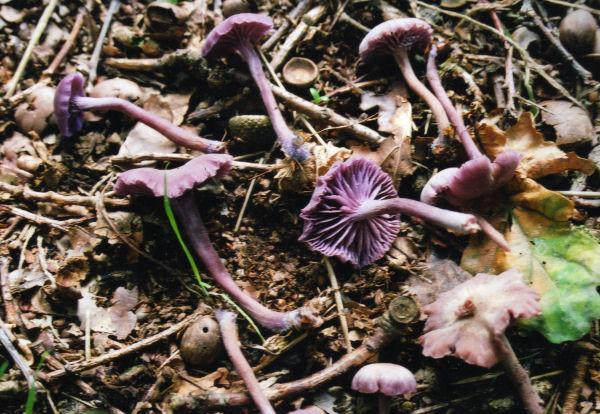
And the similar purple species, the amethyst deceiver, Laccaria amethysta


Thats from Thetford forest, same roll of film as the other pic so only more or less the same time as the deceivers.

They're both slight little shrooms, only a few of centimeters across and the shape is very variable. But when found in profusion they're really nice and tasty, well worth having.
PostPosted: Thu Oct 26, 06 10:43 am Post subject: Reply with quote

Agrocybe cylindracea


"...cream at first, darker brown with age, with persistent ring which soon becomes dusted brown by the spores. Flesh white in the cap and stem, brown in the stem base. Taste nutty, smell of old wine casks. Habitat in tufts wood especially willows and poplars. Season all year round."

More About Mushrooms

More About Mushrooms

What is a mushroom? Mushrooms are actually the fruits of fungus. The fungus itself is simply a net of threadlike fibers, called a mycelium, growing in soil, wood or decaying matter. Mushrooms on a mycelium are like apples on an apple tree.

The function of a mushroom is to produce spores, which are the "seeds" of the fungus. Some kinds of mushrooms produce their spores on gills (the gilled fungi);some in pores (the pore fungi); some on teeth (the tooth fungi); some inside a leathery pouch (the puffballs); some on the inside of shallow cups ( the cup fungi, including the morels); and some simply on the surface of the mushroom (coral fungi and others). The spores form on these various structures, then fall off to blow away on the wind or be carried by animals, water or insects. If a spore lands in a suitable spot, it germinates and grows into a new mycelium.

The mushrooms most people recognize are the gilled fungi. These typical parasol-shaped mushrooms have caps with bladelike gills on the underside and stems with or without rings. The pore fungi are similar in appearance but have a spongy layer of tubes of pores on the underside of the cap instead of gills.

Collecting mushrooms

Mushroom collecting requires only the simplest of equipment: a flat-bottomed basket or box, a roll of waxed paper, a digging tool and a pencil and paper for notes.

Be sure to collect the entire mushroom, including the base. Take only fresh, young specimens that are free of insect damage. Each type of mushroom should be wrapped separately in waxed paper (not plastic wrap, which hastens decay), along with any notes you might want to make about the habitat and appearance of the mushroom. It's a good idea to note where the mushroom is growing (on wood, soil, moss); whether it is single or in clusters' the colors of the caps, gills and stem; and any other distinctive features. The more you can observe about the mushroom in the field, the easier it will be to identify at home.

Making a spore print

Individual spores are too small to be seen with the naked eye, but you can make a spore print that will show the color of the spores in mass. This color is an important identifying characteristic for many mushrooms, especially the gilled fungi.

To make a spore print, cut the stem off the mushroom and place the cap gill-side or pore-side down on a piece of white paper. To best see the spore color, use on sheet of black paper and one of white, taped together side-by-side. Cover with a bowl or jar. If the mushroom is at the right stage-not too young, too old or deteriorated-the spores will slowly collect on the paper. A spore print will be visible in one to 12 hours.

how to make a spore print

Edible or Poisonous?

Edible or Poisonous?

The first question most people want answered about a mushroom is "Is it poisonous?" followed closely by "Can I eat it?"
The first rule for those who choose to eat wild mushrooms is "When in doubt, throw it out."

The fact is that there are many excellent edible wild mushrooms that almost anyone can learn to identify. There are also deadly poisonous species that every collector should be familiar with.
However, there are no simple rules that can reliably tell you which mushrooms are poisonous and which are edible. The only way to safely collect wild mushrooms is to be familiar with the characteristics of the species you wish to collect. The best way to learn these characteristics is to go collecting with experts who can teach them to you. LAMS hosts several mushroom forays where beginners can start.

Beginners should never rely solely on their own identifications to identify edible mushrooms based on any field guide - especially ones that only provide photographs and brief descriptions. If you have found some mushrooms and wish to get them identified see our contact page. Also check our recommended reading page for various websites, books, and journals that can help you learn to identify mushrooms.

history-of-edible-mushrooms

Wednesday, August 20, 2008

Chicken of the Woods (Laetiporus sulphureus)


Chicken of the Woods (Laetiporus sulphureus)

Laetiporus is a genus of bracket fungi growing throughout much of the world. Chicken of the Woods (Laetiporus sulphureus), also known as the sulphur polypore, is a safe and easily recognized edible mushroom with a soft texture and no gills. The mushroom grows in large brackets – some have been found that weigh over 45 kg, and they can be 5-60 cm across. It is most commonly found on oak trees, though it is also frequently found on yew, cherry wood, sweet chestnut, and willow. You may find this mushroom during the summer and autumn, but rarely in winter or spring.

This large, brightly coloured edible mushrooms is typically found in clusters but is occasionally solitary. Chicken of the Woods is leafy in shape and grows in a semi-circular form around tree trunks or stumps. Bright yellow and colourful when young, the Chicken of the Woods begins forming with multiple thick, petals that develop a bright ivory and yellowish-orange colouring on a velvet-like outer skin. It tends to lighten in colour near the edges. This edible mushroom has no gills, instead its bright yellow undersurface is covered with tiny pores. As it matures, it becomes thinner and speckled with many small dark brown spots that develop into a mixture of tan and off-white shading as the fungus gets lighter in colour and becomes shaped like a wrinkled fan with multiple leafy protrusions. When young, it is thick and juicy with a soft and spongy texture, becoming hard and brittle or crumbly as it ages. Chicken of the Woods should be harvested when they are young and tender, as older specimens get more woody and develop a sour flavour. Specimens that are found attached and growing on conifers and eucalyptus are considered inedible.

Chicken of the Woods grows in trees that are either living (as parasites) or decaying (as saprobes). The mushrooms cause a reddish brown cubical heart-rot of wood and can destabilize a tree by hollowing out its centre. Although rarely fatal to the host tree it may cause it to decay to the point where wind or hail could knock it down. Historically, this fungus was known to damage the wooden ships of the British Naval Fleet.

This is an unmistakable mushroom and you will not confuse it with any poisonous species.

If you find a Chicken of the Woods then do not simply tear it from the tree because this will damage the mycelium and could kill the parent fungus and stop it growing again in future. However if you cut off a chunk close to the tree new mushroom growth will resume next season. You can harvest the edible mushrooms and return the next year for another crop. Or cut just the outer edge (about 5 cm of the fungus) and return later in the season for a second helping.

It is bizarre looking mushroom, and is quite popular for human consumption in some areas, although it has a very woodsy and fungus like flavour and a strong fungusy smell which some people find off putting. Chicken of the Woods actually behaves a lot like chicken when cooked, having flaky white flesh and can be prepared in most ways that you prepare chicken meat. Chicken of the Woods is a good choice for vegetarians as a mock-meat menu item. When cooking Chicken of the Woods, make sure that it is fully cooked, as there are reports of people being adversely affected when the mushroom was not cooked. This is believed to be due to a number of factors that range from very bad allergies to the mushroom's protein, to toxins absorbed by the mushroom from the wood it grows on (for example, hemlock), to simply eating specimens that have decayed past their prime. As such, many field guides request that people who eat Chicken of the Woods exercise caution by only eating fresh, young brackets and begin with small quantities to see how well it sits in their stomach

Chicken of the Woods should be used within several days of being picked. Store it in a paper bag in the fridge before using it, and make sure to brush it gently to remove dirt and plant material before cooking it. Use only leafy and tender sections of the mushroom . It does not dry well, although some mushroom hunters have found that it can be frozen for long periods of time and retain its edibility. In certain parts of Germany and North America, it is even considered a delicacy. The best way to preserve it is to fry small pieces in butter and then freeze them for up to three months.

The flavour is somewhat like chicken. Meaty in texture, it has a noticeable aroma and flavour that provides an excellent enhancement to rice, risotto, curry, and various chicken or poultry dishes, such as chicken and turkey casseroles. Adding bite size chunks to pork or chicken casseroles or curries for the last 20 minutes of cooking will add a wonderful extra depth and taste to the meal. The mushroom can also be sautéed in butter, flavoured with garlic, onions or shallots, and served as a side dish or an ingredient in egg dishes.

Chicken of the Woods Omelette recipe

INGREDIENTS
  • 1 cup diced Chicken of the Woods
  • 1/4 cup shredded cream cheese
  • 2 or 3 shallots, diced
  • 1 Tablespoon chopped fresh parsley
  • 5 or 6 eggs
  • 1/2 cup cream or milk
  • Salt and pepper
  • 3 Tablespoons butter

Melt the butter in a heavy frying pan over low heat. Beat the eggs and cream, add salt and pepper to taste and pour into the pan. As the eggs start to cook, sprinkle the Chicken of the Woods, cheese, shallots and parsley over the top. Cook for 1 to 2 minutes more until the egg mixture sets. Fold the omelette over and remove from the heat; cover and let sit for 1 minute....mmm nice taste !

History-of-edible-mushrooms